
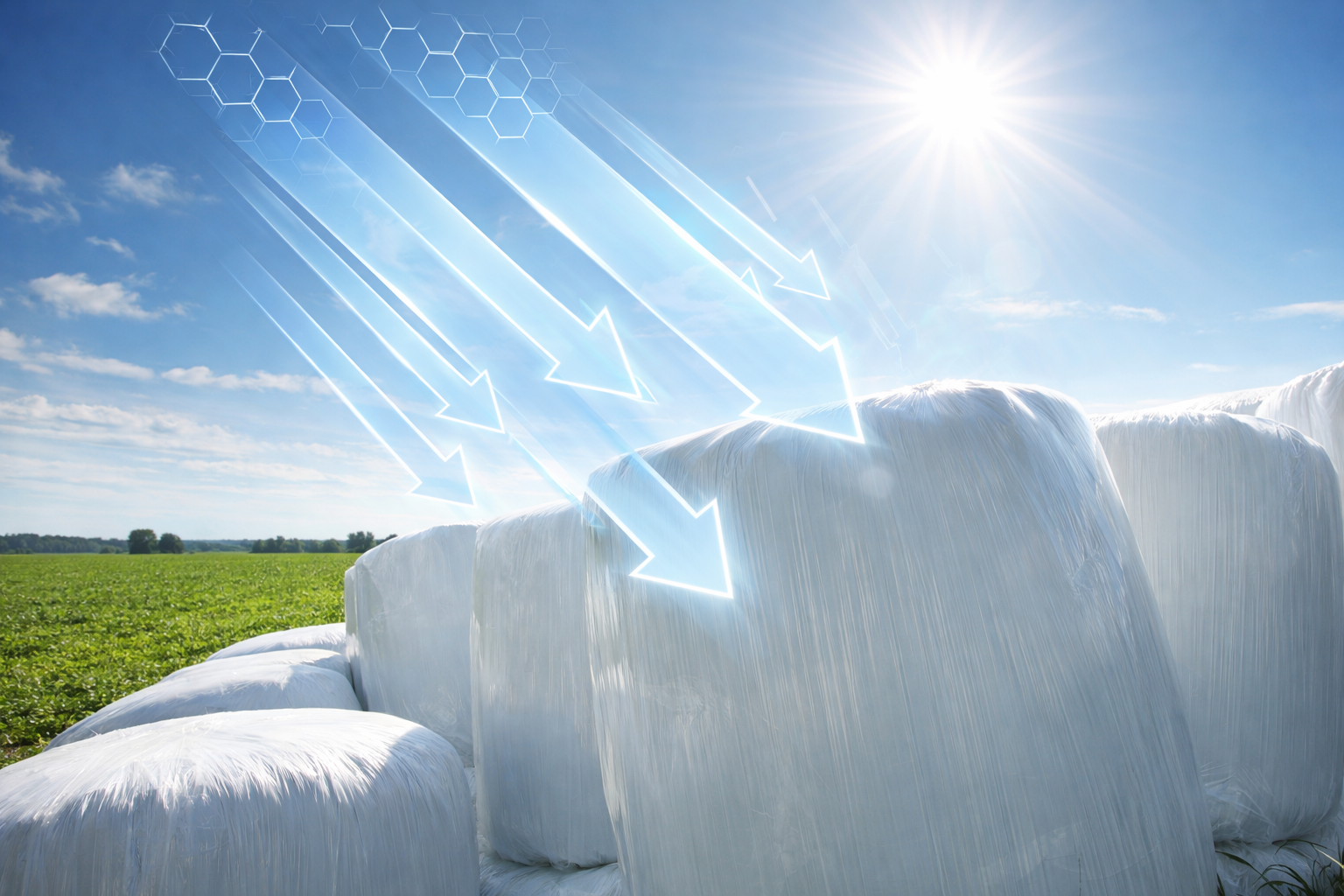
Why It Matters for Silage Quality and Reliable Bale Handling
Agricultural plastics such as silage stretch film and baling nets operate in one of the most demanding environments for polymers: continuous outdoor exposure to sunlight, temperature fluctuations, oxygen, and environmental contaminants.
Without proper UV stabilization, these materials can lose strength quickly, leading to film failure, damaged bales, and silage spoilage.
At Polypak, we have more than 20 years of experience developing and stabilizing agricultural films and nets that perform reliably in climates around the world — from Northern Europe to the most demanding high-radiation regions.
Why UV Stabilization Is Critical
Sunlight contains ultraviolet (UV) radiation, which gradually breaks down plastic materials.
When UV protection is insufficient, the polymer structure begins to degrade.
What happens to silage stretch film
If UV protection is too low, the film can:
• Become brittle
• Lose mechanical strength
• Tear during storage
• Allow oxygen to enter the bale
Once oxygen enters, the silage can heat, mold, and lose nutritional value, directly affecting feed quality and farm economics.
What happens to baling nets
UV degradation also affects baling nets:
• Fibers weaken over time
• Nets may break during handling or transport
• Bale structure becomes unstable
• Additional labor and material waste occur
Proper stabilization ensures the product maintains its strength throughout the entire storage period.
Understanding kLy – Measuring Solar Exposure
The durability of agricultural plastics is not determined simply by time, but by total solar radiation exposure.
For this reason, UV durability is commonly expressed in kLy (kiloLangley).
A Langley measures the amount of solar radiation received on a surface.
The higher the kLy value, the greater the UV exposure the material can withstand.
Different regions of the world receive very different amounts of solar radiation each year.
Typical annual ranges include:
| Region | Typical Solar Exposure |
| Northern Europe | ~90–120 kLy |
| Central Europe | ~120–140 kLy |
| Mediterranean regions | ~140–160 kLy |
| High-radiation regions (Middle East, Australia) | 160–180+ kLy |
Polypak agricultural films and nets are typically stabilized to 170 kLy, which corresponds to more than 12 months of outdoor durability in most regions of the world.
For regions with particularly demanding solar conditions, products can be supplied with further boosted stabilization levels above 200 kLy.
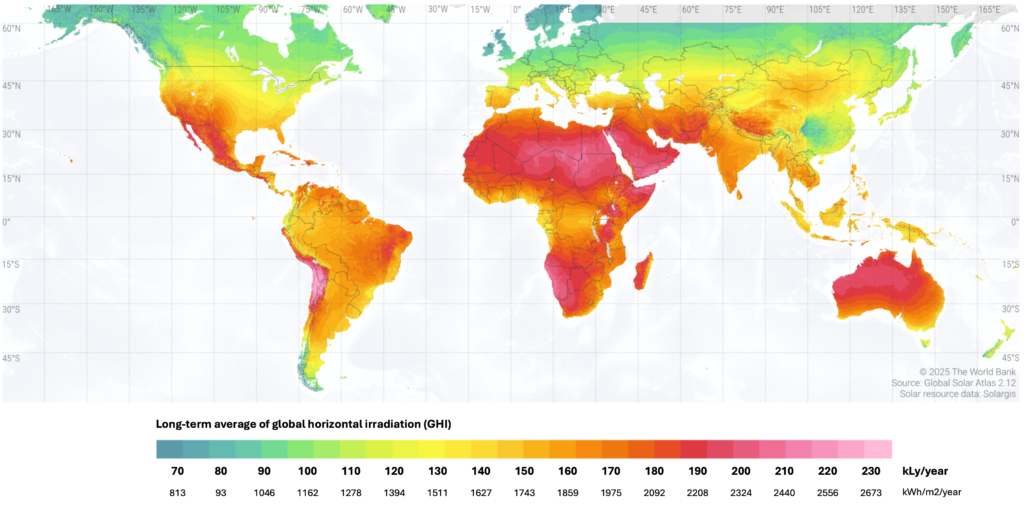
A global solar radiation map illustrating typical annual kLy levels across agricultural regions.
How UV Stabilization Works
Modern agricultural plastics rely on advanced stabilization systems to prevent UV damage.
Two main groups of additives play a key role.
HALS – Hindered Amine Light Stabilizers
HALS are the primary UV stabilizers used in agricultural films and nets.
Their function is to protect the polymer chains from degradation caused by UV radiation.
When UV radiation generates reactive molecules (free radicals) inside the plastic, HALS stabilizers neutralize these radicals before they can break polymer chains.
One of the key advantages of HALS technology is that the stabilizers continuously regenerate themselves, allowing long-term protection even under intense sunlight.
This makes HALS the backbone of modern UV stabilization systems.
Antioxidants
Antioxidants protect the polymer during production and long-term storage.
During extrusion and processing, polymers are exposed to high temperatures and oxygen. Without antioxidants, this could cause premature degradation.
Antioxidants therefore:
• Protect the polymer during manufacturing
• Prevent oxidation during storage
• Maintain mechanical strength over time
Together, HALS stabilizers and antioxidants form a balanced stabilization system ensuring long-term performance in the field.
Environmental Factors That Influence UV Degradation
Solar radiation is not the only factor affecting the durability of agricultural plastics.
Several environmental conditions can accelerate degradation:
• High temperatures
• Air pollution (ozone and nitrogen oxides)
• Dust and sand particles
• Agricultural chemicals
For example, in regions with significant air pollution or desert dust, degradation can occur faster than expected based on solar radiation alone.
This is why stabilization must be designed with real environmental conditions in mind, not just laboratory assumptions.
The Importance of Polymer Quality
UV stability does not depend only on additives.
The quality of the base polymer also plays a critical role.
High-purity polyethylene provides:
• Better additive dispersion
• Higher mechanical strength
• More consistent aging behavior
Polypak combines high-quality polyethylene from leading global suppliers with optimized stabilization systems to ensure consistent performance.
Testing and Quality Control
Reliable UV performance cannot be achieved through formulation alone — it must be verified through testing.
At Polypak, stabilization systems are validated through:
• Accelerated weathering tests
• Mechanical testing after aging
• Continuous production monitoring
• Field performance feedback from global markets
These controls ensure that the film or net delivered to farmers performs reliably throughout its intended service life.
Over 20 Years of Experience
For more than two decades, Polypak’s products have been used in demanding agricultural environments across the world.
This experience has helped us understand how different climates, storage conditions, and agricultural practices influence material performance.
By combining this practical experience with modern stabilization technology, we design agricultural plastics that farmers and distributors can trust.