
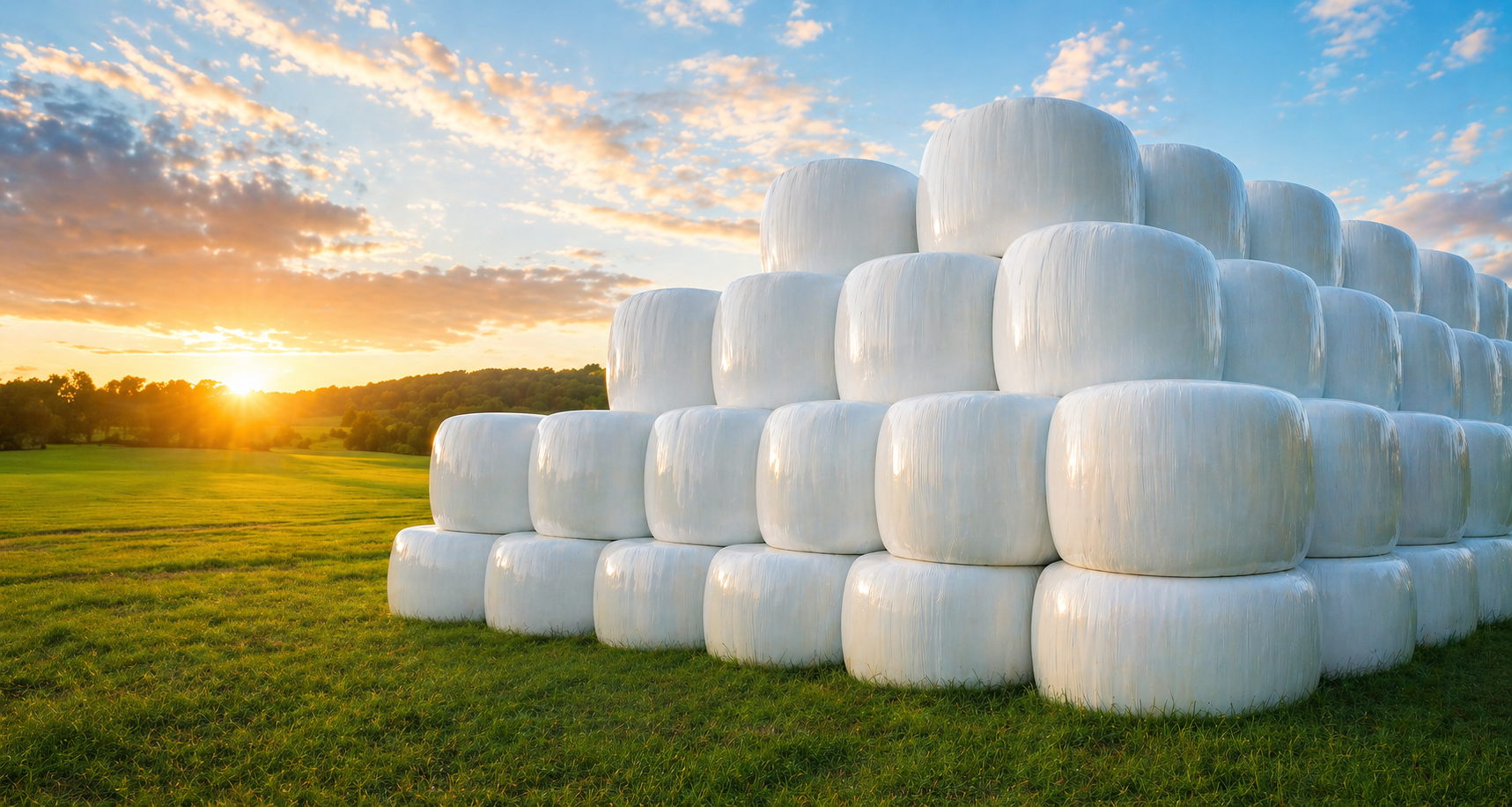
Mold in silage bales is most often caused by air ingress, poor sealing or handling damage. Even small issues in the baling and wrapping process can lead to significant spoilage and reduced feed quality.
By controlling key factors such as material selection, wrapping quality and bale handling, the risk of mold can be significantly reduced. The following points highlight practical measures to improve bale preservation and overall silage quality.
1. Selecting the correct net and wrapping film
Preventing mold starts with choosing the right materials for the crop and baling conditions. The net must be suitable for the crop type and bale density, as poor spreading or insufficient strength can lead to uneven bale shape and weak shoulders.
The wrapping film is equally important. A high-quality blown silage film should provide stable cling (tack) between layers, helping to prevent oxygen entering between overlaps. It should also have sufficient holding force to reduce bale swelling, good puncture resistance to prevent damage, and an effective oxygen barrier.
In general, multi-layer blown films offer better oxygen barrier properties than standard cast films, supporting improved sealing and silage preservation.
Polypak baling nets and silage films are designed to provide consistent strength, reliable wrapping performance and stable roll-to-roll quality in demanding field conditions.
2. Sufficient number of wrap layers
The number of film layers applied to the bale directly determines the total film thickness and the level of oxygen protection. Insufficient layers increase the risk of oxygen ingress, leading to mold development and reduced silage quality.
As a general guideline, a minimum of 6 layers should be applied when using net wrap. In more demanding conditions 8 layers or more are recommended to ensure sufficient sealing and protection.
Uniform overlap and consistent film application are equally important. Poor overlap or uneven wrapping can create weak points where oxygen can enter, even if the total number of layers is sufficient.
Polypak silage films are designed for stable pre-stretch performance and consistent thickness, ensuring reliable layer formation and effective sealing under varying field conditions.
3. Correct dry matter at baling
Dry matter content has a direct impact on bale density and fermentation.
Material that is too wet can lead to poor fermentation, while overly dry material reduces compaction and increases the risk of air pockets inside the bale.
As a general guideline, silage should be baled at approximately 30–45% dry matter, depending on crop type and conditions.
Maintaining the correct dry matter range helps achieve high bale density and stable anaerobic conditions, reducing the risk of mold development.
4. High bale density
High bale density reduces the amount of trapped air inside the bale and improves fermentation conditions.
Low-density bales contain more air pockets, increasing the risk of oxygen ingress and mold development.
Bale density is influenced by:
- baler settings and pressure
- crop condition and dry matter
- the strength and performance of the net or film
Using net with sufficient tensile strength and consistent spreading helps maintain bale shape and allows higher, more stable density.
5. Immediate wrapping after baling
After baling, oxygen is present inside the bale and aerobic activity begins immediately, leading to heat generation and quality loss.
Bales should therefore be wrapped as soon as possible after baling to minimize oxygen exposure and preserve silage quality.
Delays increase the risk of heating and microbial activity before the bale is sealed.
6. Proper bale handling after wrapping
Freshly wrapped bales are still unstable. The film layers have not yet fully bonded, and the bale can easily deform or the film can be damaged.
Handling bales too soon or under incorrect conditions can reduce layer adhesion and create weak points where oxygen can enter.
Best practice is to either:
- move bales immediately after wrapping using appropriate equipment, or
- allow time for the film layers to stabilize before transport
Avoid repeated handling, excessive pressure or sharp contact surfaces, as these can compromise the sealing performance.
7. Avoiding damage during handling
Mechanical damage to the film is a direct cause of oxygen ingress and mold development. Even small punctures or cuts allow continuous air penetration into the bale.
Bales should be handled carefully to avoid damage from equipment, transport or storage conditions. If the film is damaged, it should be repaired immediately to restore airtight conditions and prevent further deterioration.
Films with good puncture resistance and consistent thickness reduce the risk of damage during handling.
8. Maintenance of wrapper pre-stretcher
Film performance depends on correct pre-stretch during wrapping. The optimal pre-stretch level is typically around 70%, ensuring sufficient film tension and proper layer formation.
Too little pre-stretch results in loose wrapping and poor sealing between layers. Excessive pre-stretch will cause film thinning, increased neck-in and reduced overlap, which weakens the oxygen barrier and increases the risk of damage.
The pre-stretcher should be kept clean and in good condition, as contamination or worn components can affect film movement and stretching behavior. Pre-stretch levels should also be checked regularly to ensure correct performance.
9. Proper storage and stacking conditions
Storage conditions have a direct impact on bale integrity during the storage period. Bales placed on wet or uneven ground are more exposed to moisture, contamination and mechanical damage.
Bales should be stored on a clean, well-drained and smooth surface. Rough or sharp materials, such as coarse gravel or debris, can damage the film and create entry points for oxygen.
Stacking should also be controlled. Excessive stacking height increases pressure on lower bales, which can cause bale deformation.
A firm, level base and moderate stacking height help maintain bale shape and film integrity during storage.
10. Protection against birds and rodents
Damage caused by birds and rodents is a common source of oxygen ingress during storage. Even small holes in the film can allow continuous air penetration, leading to mold development over time.
Bales should be stored in areas with low risk of animal activity where possible. Regular inspection is important, and any damage should be repaired immediately to maintain airtight conditions.
Maintaining good film quality with adequate puncture resistance also helps reduce the impact of external damage.